
I recently posted a link to an article from Adam Grant, a leading organisational psychologist and Professor at Wharton University. He highlighted research that indicated that people need to be in the office about 2.5 days per week to maintain a sense of connection and identification with an organisation. Someone noted that research was done more than a decade ago, when our tools for collaboration were much less developed and asked if there was more recent data.
Like so many responses to COVID, the short-term ‘work from home’ (WFH) shift is an acceleration of a longer-term underlying trend. US research reports the trend toward ‘working from home’ was growing at ca. 10% per annum over the last decade for employees (excluding the self-employed).
But real evidence of the long-term 'stickiness' of the recent WFH acceleration will take time. At an anecdotal level in Western Australia – which is well advanced in terms of a return to pre-COVID interactions – I am seeing a mix in terms of the embrace of WFH. In one mid-tier accounting practice, everyone has happily returned; in another it seems almost no-one wants to return to the office.
Some majors are looking to 'lock in' WFH. Whether this delivers the results they hope remains to be seen. Before committing too quickly, they might ponder the move to open-plan offices. Many large companies embraced open planning on the basis it would induce more collaboration – and reduce the cost of offices.
But it seems we don’t always get what seems intuitively obvious:
"As the physical and technological structures for omnichannel collaboration have spread, evidence suggests they are producing behaviours at odds with designers’ expectations and business managers’ desires. In a number of workplaces we have observed for research projects or consulting assignments, those structures have produced less interaction—or less meaningful interaction—not more
…when firms switched to open offices, face-to-face interactions fell 70%.
The work from home is just one of the COVID-19-induced accelerations. We’ve seen similar trends across a number of domains:
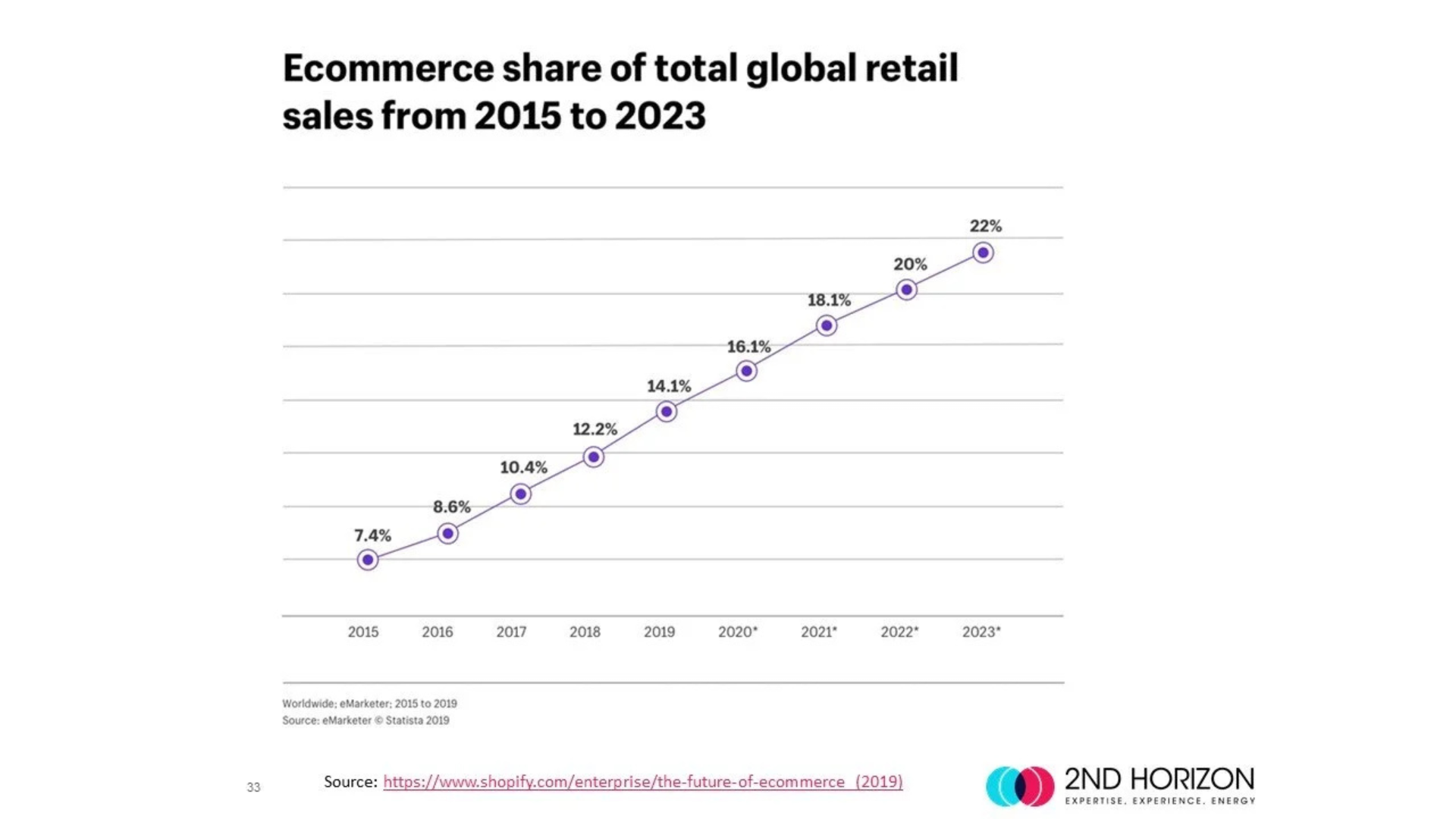
E-commerce. The trend to e-commerce has been happening since the early days of Amazon. Over the last 5 years, the e-commerce share of retail has been growing at around 1-2% per annum. According to a 2019 report by Shopify, e-commerce was expected to capture around 16% of global retail trade in 2020.
Since COVID, the estimates of e-commerce share of retail spend are around 28%. COVID has essentially compressed 7-8 years into 4-6 months.
The cashless society. In 2019, just 27% of consumer payments in Australia were made with cash in Australia, down from 37% in 2016 and 69% in 2007. In Sweden, just 13% of survey respondents paid cash for their latest transaction.
Within a matter of days of COVID-19 cases being diagnosed in Australia, cash suddenly became unacceptable currency in the few businesses that remained open. This, despite evidence that currency doesn’t transmit COVID-19 and keypads for PIN entry represent a bigger risk.
Online Food services. In the pre-COVID US, already 65% of food prepared in restaurants was consumed off premises. The reality is the restaurant business model was broken pre-COVID. One restaurateur quipped: ‘I didn’t do this to put food in boxes’.
In the early stages of COVID-19, that shifted to 100%. This has relaxed in some States/countries depending on the stage of the Government responses.
Virtualisation of services. Two stand out arenas where COVID has pushed the sector into an online format for service delivery are education and medicine.
Pre-COVID, an estimated 15% of university students studied online in Australia. During COVID, that has flipped to virtually 100% online. IBIS reported ‘online education’, which is much more than just online university, growing at more than 8.5% per annum for the last five years
Pre-COVID telemedicine in the US represented ca. 11% of the sector. In Australia it was effectively zero. Today in Australia, one large GP practice is now delivering 50% of its practice via telemedicine.
The broader strategic question is: by 2025, how much of these changes will remain? Renowned US academic and author Adam Alter (New York Times bestselling author of Irresistible and Drunk Tank Pink) observed:
“We massively overestimate the extent to which things change in response to mass events … the end of history illusion leads us to think ‘we’ve arrived’. But today is simply part of whatever journey we’re on”
At this time, more than ever, companies need to lift the quality of their strategic thinking and their strategic conversations. Have you developed a framework for thinking through the ‘stickiness’ of these COVID-induced accelerations, and interpreting their longer-term impact on your business model?
As they say, to every complex problem there is an easy answer which is clear, simple and wrong.
Good luck.
DDB